
When it comes to skin care, using more products does not always mean better results. In fact, overloading your skin can disrupt its natural balance, weaken its barrier, and lead to irritation or breakouts. Healthy skin responds best to thoughtful layering, quality ingredients, and consistent care.
At Source Vitál Apothecary, we believe skin thrives when supported, not overwhelmed.
Why We Think More Is Better
Modern beauty culture often promotes longer routines and heavier application. Ten-step regimens. Multiple active ingredients. Thick layers are applied in the morning and at night. It is easy to believe that if a little works, more must work better.
But your skin is a living organ. As the largest organ in the body, it functions as both a protective barrier and an organ of elimination. When too much product sits on the surface, especially incompatible formulas, the skin can struggle to breathe, regulate oil production, and maintain equilibrium.
Overuse can lead to:
-
Congested pores
-
Redness or sensitivity
-
Increased oiliness
-
Dry, tight skin from barrier disruption
-
Product pilling and poor absorption
Instead of improving results, excess can create new concerns.
The Skin Barrier: Your First Line of Defense
Dermatological research consistently shows that a healthy skin barrier is essential for maintaining hydration and protecting against environmental stressors. According to the American Academy of Dermatology, barrier damage can lead to increased transepidermal water loss and inflammation.
When you apply too many layers, particularly exfoliating or highly active ingredients, you can compromise this delicate system. Skin that feels tight, shiny, or reactive may not need more product. It may need less.
Source Vitál’s philosophy is rooted in balance. We focus on mineral-rich seaweeds, essential oils, and botanicals that nourish the skin without overwhelming it.
Signs You May Be Using Too Much
If you are unsure whether your routine is excessive, look for these subtle signals:
-
Your moisturizer never seems to fully absorb
-
Your skin feels sticky or coated hours after application
-
Breakouts increase despite adding more treatment products
-
Your skin swings between oily and dry
Often, reducing the amount used or simplifying your routine restores clarity.
Quality Over Quantity
Instead of layering multiple heavy creams, focus on products that deliver meaningful nourishment in appropriate amounts.
For example:
-
A pea-sized amount of moisturizer is typically sufficient for the entire face
-
Two to three drops of a facial oil can support the lipid barrier without clogging pores
-
Masks used once or twice weekly are often more beneficial than daily application
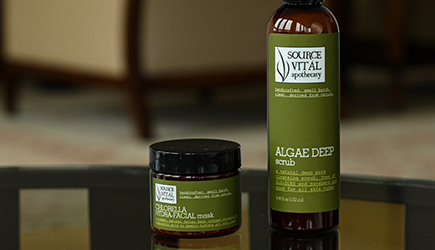
Our seaweed-based masks and mineral-rich creams are formulated to work efficiently with modest application. When ingredients are well-sourced and thoughtfully blended, your skin doesn't need excess.
The Role of Detoxification and Remineralization
From a holistic perspective, skin health is also connected to internal balance. Overloading the skin externally can mirror internal overload. Gentle detoxification through seaweed baths, body brushing, and mineral therapy supports circulation and elimination without harsh stripping.
Topical care should support these natural processes, not interfere with them.
How to Right-Size Your Routine
If you suspect your skin is overwhelmed, try this simple reset:
-
Cleanse morning and night gently.
-
Apply a balanced toner or essence.
-
Use one targeted treatment.
-
Finish with an appropriate amount of moisturizer.
Pause exfoliants and strong actives for one week. Allow your skin to recalibrate. Often, clarity and comfort return quickly.
Less Product, More Intention
Skin responds to consistency and care, not excess. When you slow down, apply thoughtfully, and choose mineral-rich botanical formulas, you give your skin space to function as it was designed to.
Healthy skin is not achieved by layering more. It is supported by balance, nourishment, and respect for the body’s natural rhythms.



Leave a comment